Should you outsource your website management?
Most businesses understand that their website needs attention. The harder question is who is actually going to give it that attention.
Most businesses do not struggle to understand that their website needs attention.
The problem is usually who is actually going to give it that attention.
A developer can fix something when it breaks.
A marketing manager can update some content.
An agency can be called when a larger project comes up.
Someone remembers to check Analytics occasionally.
Eventually the website becomes everybody's responsibility and nobody's responsibility at the same time.
That is where outsourced website management starts to make sense.
Not because outsourcing is automatically cheaper.
Because it can give a business access to the range of expertise a useful website now needs without having to employ all of it internally.
Website management is bigger than website maintenance
These two things are often treated as the same service.
They are not.
Website maintenance keeps the underlying website healthy. Updates, backups, security, hosting issues and technical fixes all belong there.
Website management asks a broader question:
What does this website need next to contribute more to the business?
That can include:
- improving important landing pages
- adding or updating content
- fixing customer journey problems
- monitoring website performance
- improving conversion points
- implementing tracking
- reviewing search performance
- making technical improvements
- supporting campaigns
- building new functionality when the business needs it
The website is not simply being kept alive.
It is being actively looked after.
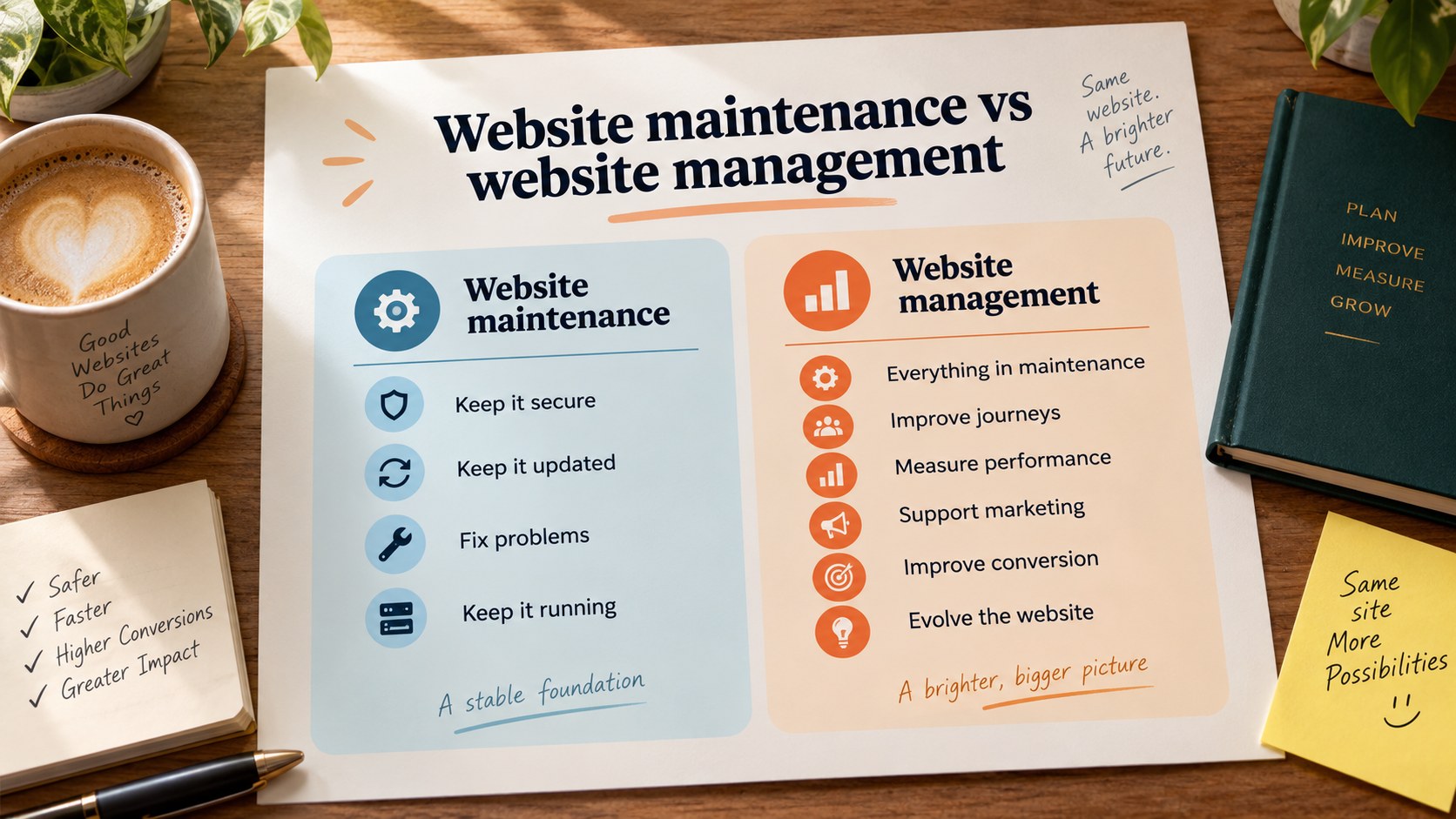
Maintenance
- Keep it secure
- Keep it updated
- Fix problems
- Keep it running
Management
- Everything in maintenance
- Improve journeys
- Measure performance
- Support marketing
- Improve conversion
- Evolve the website
Keeping a website working and making a website work harder are different jobs.
Why does outsourcing make sense?
The modern website sits across several disciplines.
A development problem needs a developer.
A confusing customer journey may need UX expertise.
Poor enquiry performance could be a conversion problem.
Traffic falling from Google may need search expertise.
A campaign landing page may involve content, design, development and analytics.
It is unusual for one person to be excellent at all of those things.
It is also unrealistic for many smaller businesses to employ a developer, designer, UX specialist, analyst and search specialist purely to look after one website.
An outsourced web team gives you a different model:
Bring in the expertise when the website needs it rather than building every capability into your payroll.
That is the real attraction.
Outsourcing does not mean handing over control
There is an old version of outsourcing where work disappears into a black box.
You send a request.
Eventually something comes back.
You are never quite sure who did it.
That is not particularly useful website management.
A good outsourced partner should actually make ownership clearer.
There should be someone responsible for understanding:
- what the business is trying to achieve
- what is happening on the website
- what needs attention
- what should happen next
- which specialist needs to handle it
The business still owns the website, accounts, data and commercial decisions.
The outsourced team owns the responsibility for helping it work properly.
The advantage is access to expertise
Location has become much less important to digital work.
The developer who understands your technical problem does not need to sit three desks away.
Neither does the analyst looking at your conversion data or the designer improving a customer journey.
What matters much more is:
- Can they do the work?
- Can they understand the business?
- Can you communicate easily?
- Can they take responsibility rather than simply complete tickets?
That is why I would not judge outsourced website management primarily by whether the supplier is five miles away or five thousand.
Expertise can be found anywhere. We look at that in more detail in why UK businesses outsource website work to South Africa.
The important part is having reliable access to it.
When outsourced website management works particularly well
It tends to make sense when a business has reached the point where the website matters commercially, but there is no dedicated web team internally.
Perhaps you have a marketing manager who already has too much to do.
Perhaps you have developers, but their priorities are internal systems rather than marketing.
Perhaps several different freelancers are doing disconnected pieces of work.
Or perhaps the website simply receives attention in bursts whenever something goes wrong.
In those situations, outsourcing can give the website something it was missing:
continuity.
Someone is actually looking after it between projects.
What should you look for in an outsourced web team?
Breadth of capability
If every problem is solved through development, you probably have a development supplier rather than a website management partner.
You want access to the skills the website genuinely needs.
Commercial understanding
A technically perfect change is not automatically a useful business improvement.
The team should understand enquiries, sales, bookings, visibility and customer journeys, not only code.
Clear ownership
You should know who is responsible and how work gets prioritised. Our how it works page sets out one way of handling that.
Access to your own systems
Your domain, hosting, website, analytics and advertising accounts should remain properly documented and accessible.
Proactive thinking
There is a difference between:
Tell us what to change.
and:
We have spotted something worth improving.
For ongoing website management, the second is considerably more valuable.
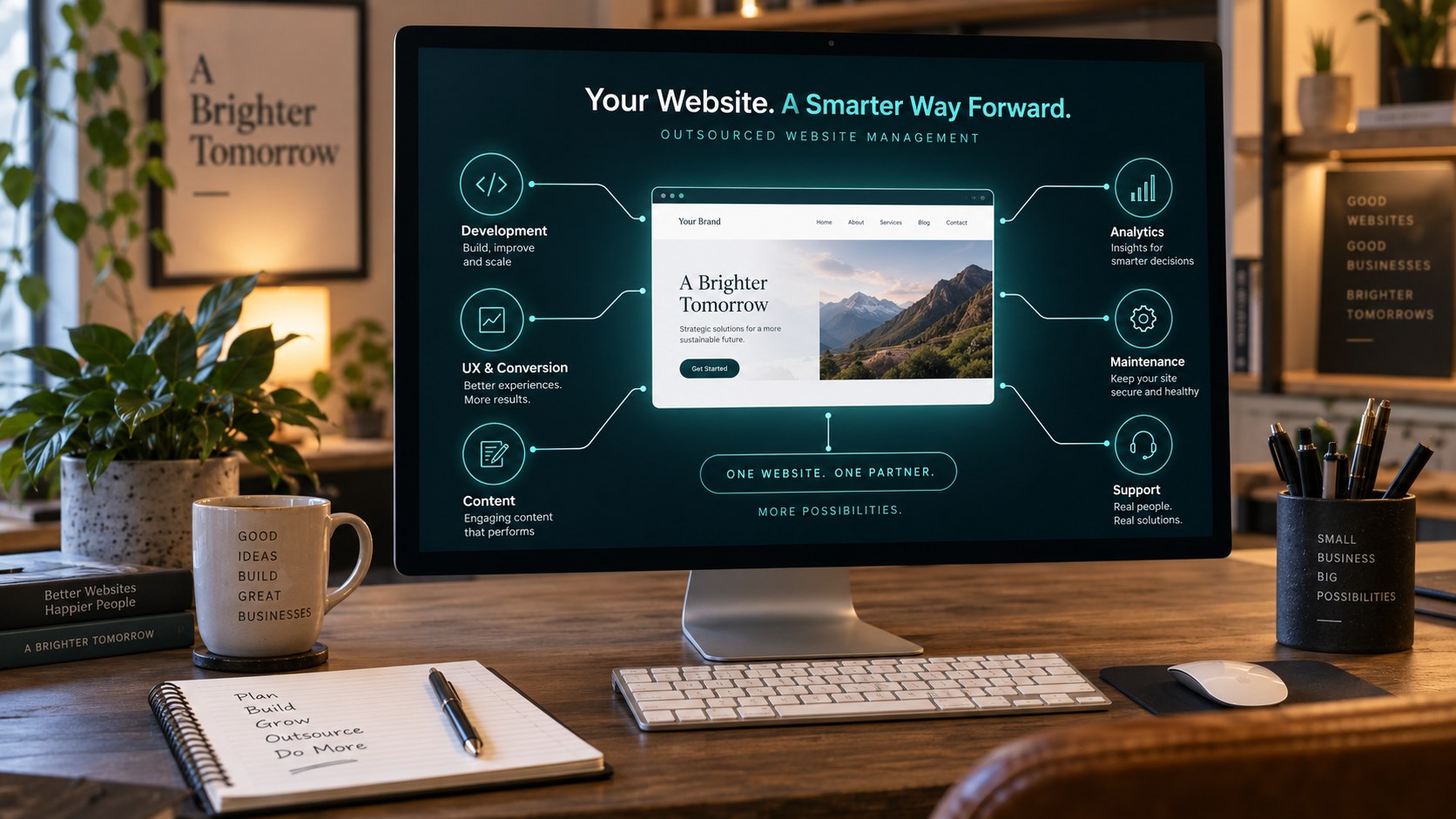
What you are actually outsourcing: responsibility for the website
- Development
- UX and conversion
- Content
- Search
- Analytics
- Maintenance
- Performance
You do not necessarily need every skill full-time. You need access to the right skill when it matters.
When should you keep website management in-house?
Outsourcing is not automatically the right answer.
If your website is central enough to the organisation to justify a strong multidisciplinary internal team, building that capability internally may make complete sense.
Likewise, if the website barely changes and generates little commercial activity, extensive ongoing management may be unnecessary.
The question is not:
Is outsourcing better than hiring?
It is:
What level of capability does this website need, and what is the sensible way for this business to access it?
We have looked at that broader choice before in our guide to agency, freelancer or in-house website support. If you want the commercial side of it, we also cover what you should actually pay for website support.
Your website does not need another supplier. It needs someone looking after it.
That is ultimately the distinction.
Outsourced website management works when the relationship moves beyond completing isolated jobs.
The website has someone paying attention to it.
Someone understands what it is trying to achieve.
And when a developer, designer, analyst or strategist is needed, that expertise is available.
You do not need every digital skill sitting inside your building.
You need the right expertise involved when it matters.
If you want to see what that looks like as an ongoing service, our website maintenance and support and services and pricing pages set it out.
If you are in the UK, working with a team outside it raises its own practical questions, covered separately.
Frequently asked questions
What is the difference between website maintenance and website management?
Maintenance keeps the website healthy through updates, backups, security and technical fixes. Management asks what the website needs next to contribute more to the business, which can include improving pages, content, journeys, conversion, tracking and search performance.
Does outsourcing website management mean losing control of your website?
It should not. The business still owns the website, accounts, data and commercial decisions. A good partner makes ownership clearer by taking responsibility for what needs attention and what happens next.
When does outsourced website management make sense?
It tends to suit businesses where the website matters commercially but there is no dedicated web team internally, or where several disconnected freelancers are doing pieces of work and nobody is looking after the website between projects.
When should website management stay in-house?
If the website is central enough to justify a strong multidisciplinary internal team, building that capability internally can make complete sense. If the website barely changes and generates little commercial activity, extensive ongoing management may be unnecessary.
Need someone to take proper responsibility for your website?
We can manage and improve the website you already have, bringing in the right expertise as it is needed rather than selling you work for the sake of it.
Let's talk