AI makes experts faster. It doesn't make everyone an expert.
The advantage is not having access to AI. Nearly everybody has access to AI. The advantage is knowing what to do with it.
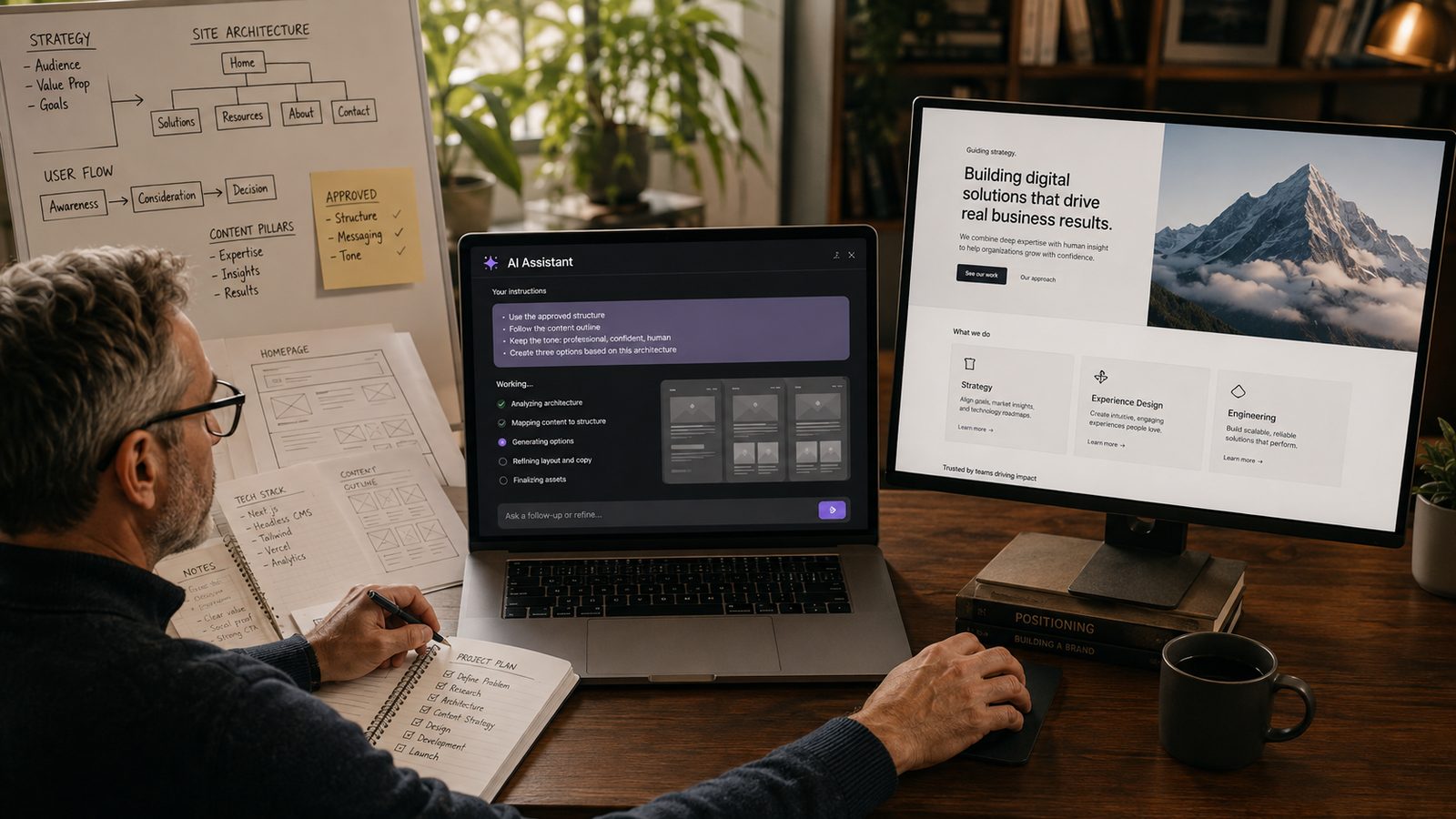
For a while, a lot of the conversation around AI was about access.
Who was using it? Which tool? Could it really save time?
That question is already becoming less interesting. AI is now part of everyday work for a huge number of people. Microsoft and LinkedIn reported in 2024 that 75% of knowledge workers were using AI at work. Stack Overflow's 2025 Developer Survey found that 84% of respondents were using or planning to use AI tools in their development process.
So "we use AI" is not much of an advantage anymore.
The more useful question is:
Who actually knows what to do with it?
Because AI can absolutely make work faster. It can generate options, draft code, summarise information, explore approaches, troubleshoot problems and remove repetitive execution.
But speed does not create expertise.
If anything, the faster the machine gets, the more important it becomes to have somebody capable directing it.
Think of it like a racing car
Give an experienced racing driver a faster car and they can use that performance.
They know the circuit. They understand where to brake, when to push, what line to take and what the car is telling them.
Put somebody with no racing experience in exactly the same car and you have not created another racing driver.
You have simply given an inexperienced person a much faster machine.
AI is similar.
The technology gives people extraordinary capability. The quality of the result still depends heavily on the expertise directing it.
faster task completion in a controlled study of developers using GitHub Copilot.
Adoption is high, but expertise still directs the result.
AI is very good at execution
This is where the value becomes real.
A developer can use AI to generate routine code, explore alternative implementations or troubleshoot an error. A designer can explore several directions quickly instead of manually producing every early variation. A writer can move from a blank page to something worth shaping much faster. An analyst can work through large amounts of information and surface patterns more quickly.
That is genuine productivity.
In Microsoft Research's controlled Copilot experiment, developers with access to the AI tool completed the programming task 55.8% faster than the control group.
The important bit is what happens around that speed.
A senior developer is not simply asking AI to "build a website".
They already understand the architecture they want, how the system should be structured, which tools make sense, what should be reusable, what could create technical debt, and how the new work needs to fit the wider codebase.
AI accelerates execution inside that expertise.
It does not provide the expertise.
The same distinction applies to strategy, design, content and analytics.
Expertise directs the work
This is why I do not think the interesting question is whether AI can produce something.
It usually can.
The better question is whether somebody knows what should be produced in the first place.
A strong strategist knows which problem is worth solving. A strong designer understands hierarchy, usability and restraint. A strong developer understands architecture, security and maintainability. A strong marketer understands the audience, proposition and commercial objective.
AI can help each of them work faster.
But it needs direction.
Stack Overflow's 2025 survey captures that tension well. AI usage among developers is extremely high, yet only 33% said they trusted the accuracy of AI output, while 46% actively distrusted it.
That is not evidence that AI is useless.
It is evidence that access to a powerful tool is not the same thing as knowing how to use it responsibly.
Source: Stack Overflow Developer Survey 2025.
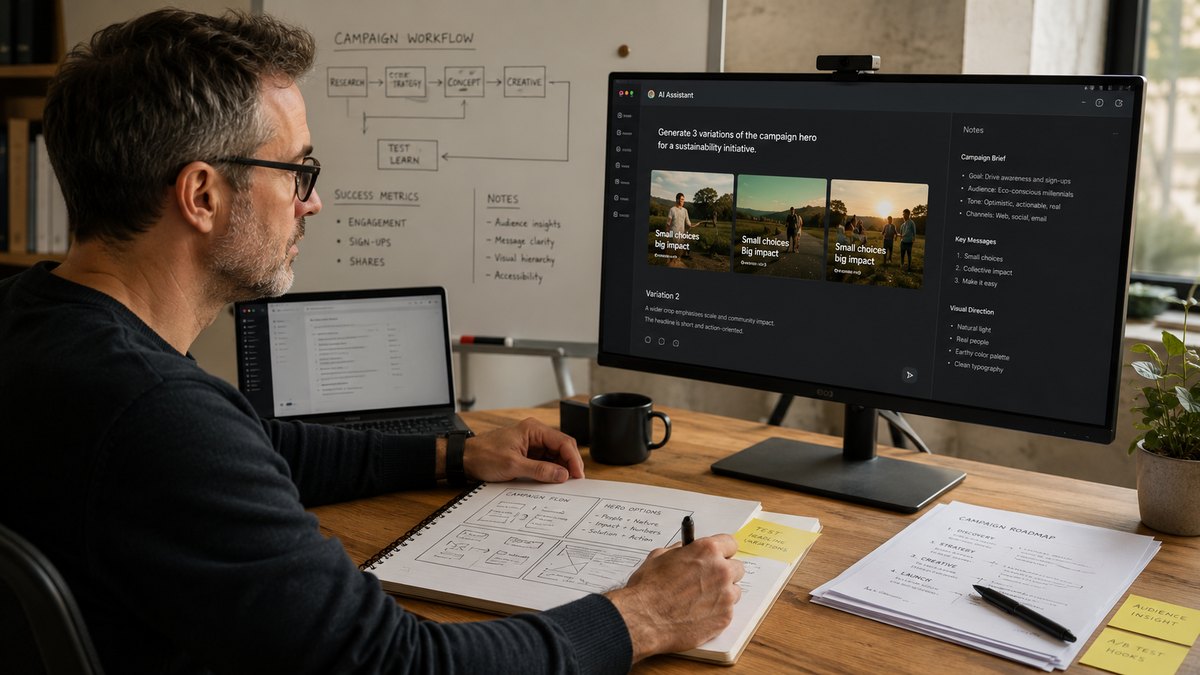
AI can make the wrong thing happen faster too
This is the part that gets lost when efficiency becomes the entire argument.
AI can accelerate good work.
It can also accelerate bad decisions.
A poorly conceived feature can be built faster. A weak message can become ten weak variations. A bad technical approach can produce a lot of convincing-looking code.
That is why the expert should not appear only at the end to "check what AI did".
The expertise needs to lead from the beginning.
It sets the goal, structure, constraints and standard. AI then helps move through the work more efficiently.
Expertise leads, AI accelerates. Reverse the order and it just fails faster.
The real gain is where experts spend their time
The best use of AI is not removing experienced people from the process.
It is removing unnecessary effort from experienced people.
You do not want a senior developer spending hours typing predictable boilerplate if that part can be accelerated safely. You want them spending more time on the architecture, performance, security and decisions that require experience.
The same applies elsewhere.
Less time formatting, repeating and producing the obvious. More time thinking, directing, improving and solving.
That is where the efficiency becomes valuable.
Lean into AI, but keep expertise in the driving seat
Businesses should absolutely be leaning into AI.
Ignoring tools that can genuinely improve productivity makes little sense.
But "using AI" is not a strategy.
The stronger question is:
Where can AI help capable people move faster without lowering the quality of the result?
The technology will keep improving. Access will keep getting easier.
That means access itself becomes less valuable as a differentiator.
The advantage is knowing what to do with it.
Frequently asked questions
Does AI automatically make a team more productive?
No. It can accelerate many tasks, but the gain depends on where it is used and how well the work is directed.
Why does expertise still matter if AI can generate so much?
Because somebody still needs to understand the objective, structure, constraints and standard required. AI can speed up execution, but it does not replace deep domain expertise.
Is AI only useful for experts?
No. It can help people at many skill levels. The point is that the strongest results usually come when the person using it understands the work well enough to direct it properly.
Want to use AI in a way that actually improves the work?
We can help identify where AI can speed up delivery, where expertise still needs to lead, and how to apply it in ways that make commercial sense.
Let's talk