What should AI actually be doing on your website?
AI can do far more for a website than add a chatbot in the bottom-right corner. The useful question is not whether your website needs AI. It is where AI can genuinely make the experience better.

For the past couple of years, putting AI on a website has often meant one thing: adding a chatbot.
Sometimes that is useful.
Sometimes it is an animated bubble that pops up before you have even read the first sentence, asks how it can help, fails to understand the question and gets closed.
That is a fairly poor definition of artificial intelligence.
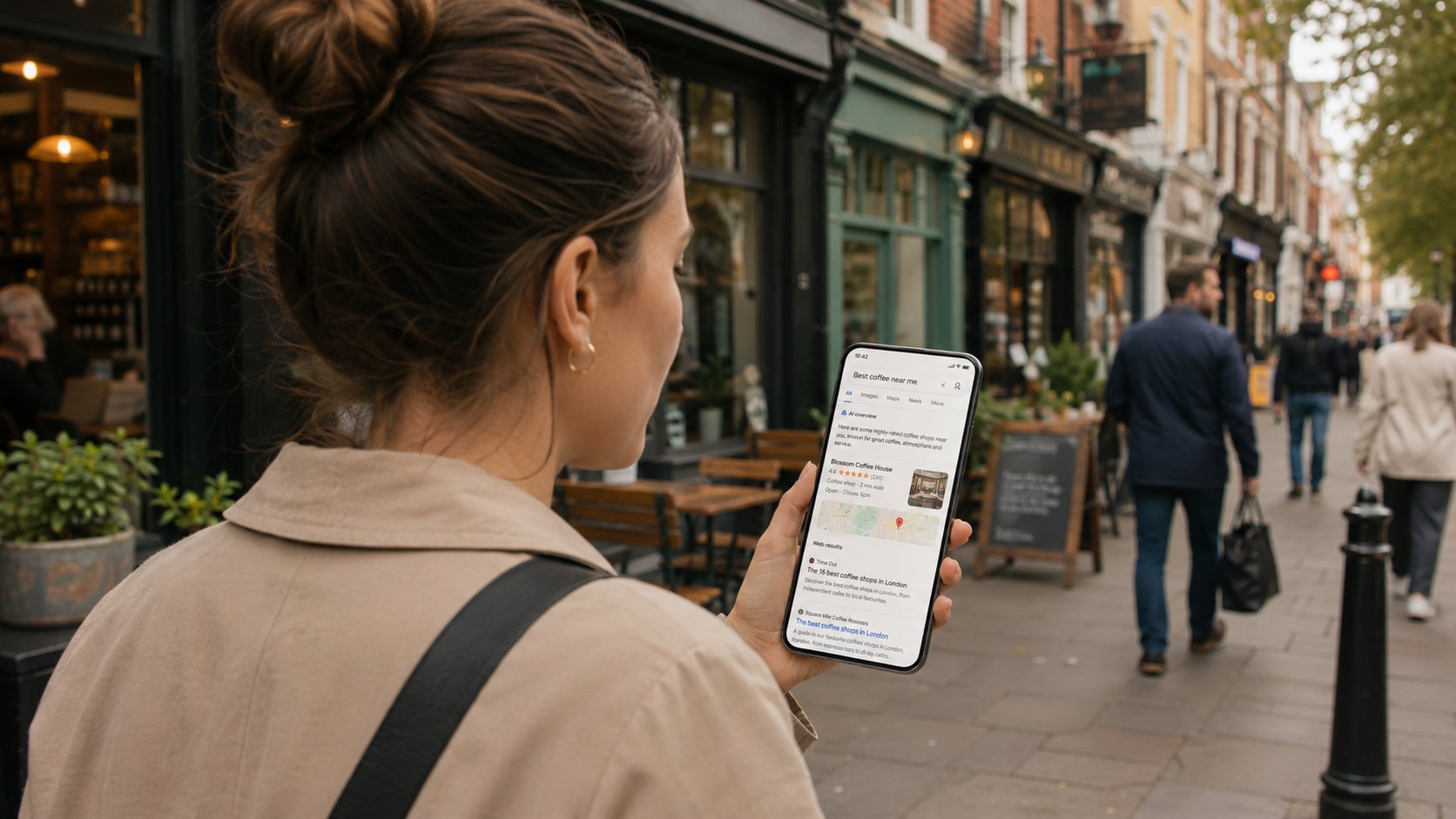
AI is becoming capable of doing much more useful work across a website. It can help people find information, understand products, compare options, get support, receive more relevant content and complete simple tasks. Behind the scenes, it can also help businesses understand what visitors are doing and where their website could work better.
The important part is choosing the right jobs.
Because AI should solve a customer or business problem. It should not exist on the website simply to prove that you have AI.
of consumers said they were only somewhat or not at all comfortable using AI tools to engage with brands.
PwC, 2025 Customer Experience Survey
said they would be likely to use AI to track an order or delivery.
PwC, 2025 Customer Experience Survey
said human interaction was moderately or very important to their experience with a brand.
PwC, 2025 Customer Experience Survey
Based on 5,511 US consumers. The point is the tension between AI adoption and a continued preference for people.
Start with the boring jobs
This might sound counterintuitive, but some of the best uses of AI are not particularly exciting.
Imagine a customer wants to know:
- whether you deliver to their area
- which of three products suits their needs
- whether a particular service is available
- where an existing order is
- which document they need
- how to make a booking
- what your returns process is
If your website already contains that information, AI can potentially help people get to the answer faster.
That is useful.
The aim is not to have a conversation with a robot. The aim is to remove unnecessary work from the customer journey.
PwC's research gives a useful clue here. Almost half of consumers surveyed were willing to use AI for something straightforward such as tracking an order, while only 29% said they would use it to make a payment.
The more consequential the task becomes, the more careful businesses need to be.
Consumers likely to use AI, by task. Source: PwC, 2025 Customer Experience Survey.
The 20-point difference is the story.
Make a complicated website easier to use
One area I think has enormous potential is website search.
Traditional site search is surprisingly unforgiving.
Search for the exact terminology a company uses and you might find what you need. Use slightly different language and you can get a blank screen telling you there are no results.
AI can understand intent rather than simply matching keywords.
A visitor could ask:
Which option is best if I need X but don't need Y?
That is a very different experience from typing two words into a search box and being shown 73 results.
For websites with lots of products, services, technical information, resources or support content, this can be far more useful than a generic chatbot.
The AI does not need to know everything in the world. In fact, it is generally better if it doesn't.
Give it access to the right information, restrict what it is expected to answer, and make it exceptionally good at helping people navigate your business.
Help people choose, not just search
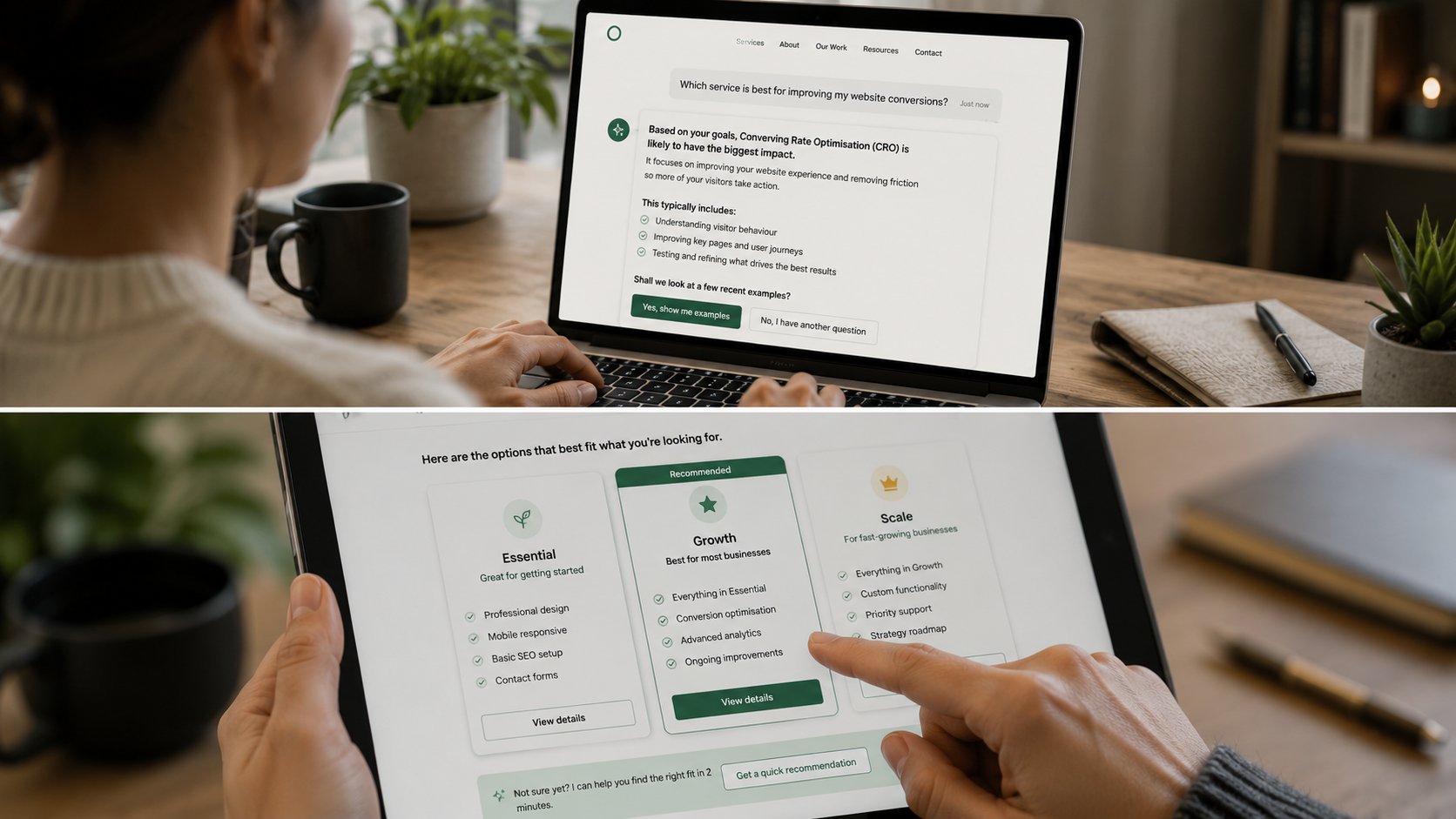
The next step is guided decision-making.
Most businesses organise websites around their own structure.
Here are our services. Here are our products. Here are our departments.
Customers do not necessarily think that way.
They arrive with a need.
A good AI-assisted experience can turn that around.
A solar company could help a homeowner understand which information is relevant before requesting a quote. A software company could recommend the most suitable package based on requirements. A large professional-services firm could guide a visitor towards the right service without expecting them to understand its internal organisational structure. An ecommerce site could help somebody compare several technically similar products.
None of this requires the AI to replace the transaction. Its job can simply be to reduce uncertainty before the next step.
Personalisation can be useful, but it can also get creepy
AI makes increasingly sophisticated personalisation possible.
That does not mean every possible piece of personalisation should be used.
There is a fairly simple line here:
Use what you know to make the experience more useful, not to demonstrate how much you know.
A returning customer being shown relevant products based on something they previously bought can be useful.
A website making it uncomfortably obvious that it has stitched together large amounts of behavioural and personal data is different.
PwC found that 53% of consumers believed sharing personal information could be worthwhile if it made their experience smoother. But 93% said mishandling that information would cause a brand to lose their trust.
That is a fairly strong warning against treating AI personalisation as a technology experiment.
AI can work behind the website too
Some of the most useful applications may never be visible to the visitor.
AI can help analyse:
- search queries that produce poor results
- recurring customer-service questions
- pages where visitors repeatedly leave
- form feedback
- website analytics
- large volumes of behavioural data
- patterns in customer enquiries
- opportunities for new content
This is where AI becomes much more interesting to me.
Instead of simply creating more content, it can help you understand what needs improving.
That could identify that people repeatedly search for a service you barely explain. Or that visitors are arriving at a particular page with a very different intention from the one the page was designed around. Or that hundreds of customers are asking the same question because the website never answers it properly.
AI can help find the pattern. A human still needs to decide what to do about it.
And yes, sometimes a chatbot is exactly right
I am not anti-chatbot.
There are plenty of situations where conversational support is genuinely useful.
But the chatbot needs a job.
Good uses include handling straightforward support questions, helping people locate information, providing service outside normal operating hours and collecting enough context to route somebody to the right human.
What it should not do is imprison a customer in an automated conversation when the customer clearly needs a person.
A 2025 global YouGov study for Zendesk, involving around 10,000 people across ten countries, found that 84% believed human interaction should always remain an option.
That seems like an excellent design principle.
The question to ask before adding any AI
Not:
Where can we put AI on the website?
Ask:
Where are customers currently doing unnecessary work?
Then look at whether AI is the best way to remove some of it.
Sometimes it will be.
Sometimes a better search function, clearer navigation, improved copy, a simpler form or three well-written FAQs will solve the problem for less money and with less risk.
AI should earn its place on a website like anything else.
If it helps somebody find, understand, decide or act more easily, it is doing useful work.
If the only achievement is making the website look as though it has AI, it probably isn't.
Could AI make part of your website genuinely more useful?
We can help identify where AI, automation or a simpler improvement would create the most value.
Let's talkFrequently asked questions
Does every business website need AI?
No. AI should solve a real problem. A simple website with straightforward customer journeys may gain much more from improving its content, speed, forms or navigation first.
Is an AI chatbot worth adding to a small-business website?
It can be, particularly when customers repeatedly ask the same questions or need help outside office hours. But it needs reliable information, sensible boundaries and an easy route to a person when required.
Can AI improve website search?
Yes. This is one of the more promising uses because AI can interpret natural-language questions and intent rather than relying only on exact keyword matches.
Should AI be allowed to make decisions for customers?
That depends on the consequence of the decision. AI can be excellent for guidance and low-risk tasks. Higher-risk financial, legal, medical or important purchasing decisions require much more care and human oversight.
Could AI make part of your website genuinely more useful?
We can help identify where AI, automation or a simpler website improvement would create the most value, and where it would just be a gimmick.
Let's talk