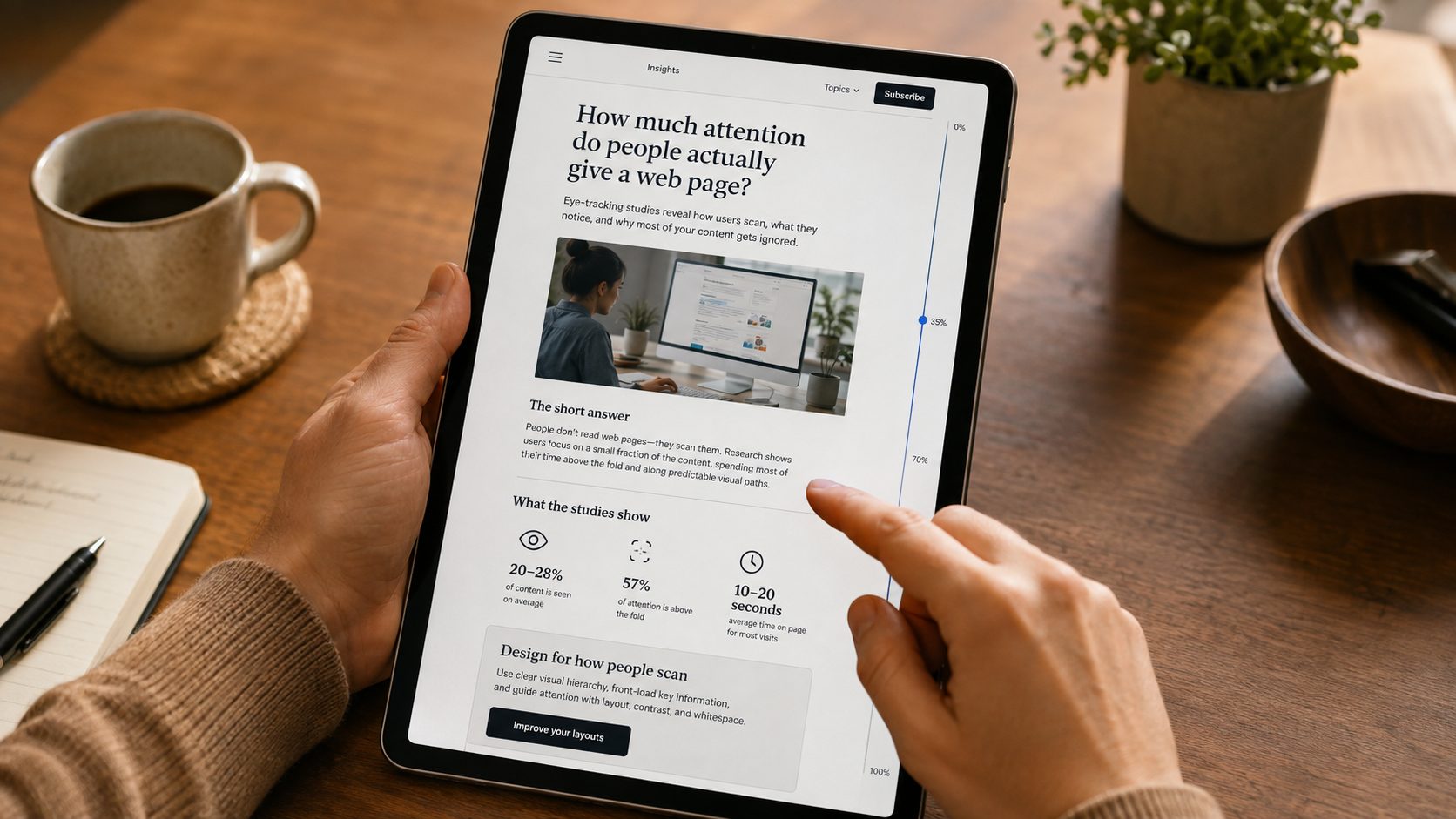
How much attention do people actually give a web page?
You've probably heard that websites have only a few seconds to grab someone's attention. The truth is more useful: visitors will spend time when a page quickly proves that the time is worth spending.

Eight seconds. Ten seconds. Fifteen seconds.
You've probably seen one of those numbers used to explain how long somebody will pay attention to your website.
They make great presentation slides.
They are much less useful for actually improving a website.
There is no universal countdown that starts when somebody lands on a page.
A person checking an opening time might spend ten seconds and leave completely satisfied. Someone comparing two expensive services could spend ten minutes. A visitor who immediately discovers they are on the wrong page might leave in two seconds.
All three behaviours can be perfectly rational.
The real question is not:
How long did they stay?
It is:
Did the page earn enough attention for that visitor to do what they came to do?
People are consuming less website content
There is good evidence that digital sessions are becoming leaner.
Contentsquare's 2026 Digital Experience Benchmark analysed 99 billion web and app sessions across more than 6,500 websites and nine industries.
Overall engagement fell 10% year on year, incorporating measures including page views, scrolling and time spent.
Its more detailed 2026 product benchmarks found page views per session down 1%, average scroll rate down 2% and time on site down 7%.
Yet bounce rates also fell across AI, organic-search and paid-search traffic.
That is interesting.
People appear to be consuming less, but that does not automatically mean they are less interested. They may simply be arriving better informed and moving more deliberately.
Page views per session, year on year.
Average scroll rate, year on year.
Time on site, year on year.
Based on 99 billion sessions and more than 6,500 websites. Source: Contentsquare, 2026 Digital Experience Benchmark.
Less consumption does not necessarily mean less intent.
We scan before we commit
This part of web behaviour is not particularly new.
Nielsen Norman Group's eye-tracking research has repeatedly shown that users scan webpages rather than automatically reading every word.
One of the best-known patterns is the F-shaped scanning pattern, where attention is concentrated near the beginning of headings and lines of copy.
NN/g's later research found that this behaviour persisted on both desktop and mobile.
But the important lesson is not that every page needs to be designed in the shape of an F.
It is that attention is earned progressively.
A visitor arrives. They scan. Something tells them they are in the right place. They look a little deeper. The page continues to answer their questions. Only then do they commit more attention.
Attention is conditional. Each stage has to be earned before the next.
The top of the page has a different job from the rest
This is why the opening screen matters so much.
It does not need to explain the entire business. It needs to give the visitor enough information to keep going.
A homepage hero that says:
Powerful solutions for a changing world
has consumed valuable space without answering much.
Who is this for? What kind of solutions? What problem do you solve? Why should I keep looking?
Something more specific does not need to be clever:
Commercial solar installation for businesses across Gauteng
A visitor can make a useful decision immediately.
Right place? Keep going. Wrong place? Leave.
That second outcome is not necessarily a failure.
A short visit can be successful
This is where analytics often leads businesses astray.
Imagine somebody searches for your telephone number, lands on the contact page, taps the number within seven seconds and calls.
Short session. One page. Almost no scrolling. Excellent outcome.
Now imagine another visitor spends five minutes on the website because they cannot work out which service they need, searches repeatedly, goes backwards and forwards through the navigation and eventually gives up.
Long session. Many page views. Terrible outcome.
The first visitor could look "less engaged" in a basic analytics report.
That is why time alone tells you very little.
Measure attention against intent
A useful analytics setup should look beyond generic averages.
For an article
- meaningful scroll depth
- time actively viewing the page
- clicks to related content
- newsletter sign-up
- return visits
For a service page
- exposure to the important proposition
- interaction with useful information
- progression to relevant FAQs or evidence
- enquiry starts
- completed enquiries
For ecommerce
- product interaction
- use of specifications and galleries
- add-to-cart
- checkout progression
- purchase
The metric only becomes useful once you understand what the page is supposed to achieve.
Scroll depth tells you where attention disappears
Scroll data can be particularly revealing.
It lets you see what proportion of visitors ever reach different parts of the page.
That does not automatically tell you why they stopped. But it gives you somewhere useful to investigate.
If only a small proportion of visitors ever see an important call to action, perhaps it is too low. If people consistently stop scrolling at the same section, maybe that section feels like the end of the page. If an important pricing explanation sits far below where most visitors stop, its existence is irrelevant to them.
Tools such as scroll maps and attention heatmaps can show how far people move down a page and which sections receive the most viewing or interaction time.
Mobile attention and desktop attention are not the same
Another reason there is no universal attention-span number is device behaviour.
Contentsquare's 2026 data found desktop represented roughly 30% of visits but 47% of time spent, suggesting desktop sessions tend to be substantially deeper even though mobile delivers more traffic.
For travel sites specifically, desktop visitors viewed 6.8 pages compared with 5.0 on mobile and spent more than twice as long on site.
That does not mean desktop is better. The devices are often being used differently.
Someone standing outside a restaurant on a phone wants a phone number and opening hours. Someone planning a two-week holiday on a laptop may happily explore for half an hour.
Design needs to respect both.
Desktop share of visits
Desktop share of time spent
Source: Contentsquare, 2026 Digital Experience Benchmark.
Stop chasing attention. Earn it.
Your website does not need every visitor to spend longer on every page.
It needs the right people to find what they need with as little unnecessary effort as possible.
Sometimes that takes ten seconds. Sometimes it takes ten minutes.
The number itself is almost meaningless without the outcome.
So rather than asking whether your average time on page is high enough, ask:
- Did they find what they came for?
- Did they see the information that mattered?
- Did they understand what to do next?
- And did enough of them actually do it?
Those are questions worth measuring.
Do you know what visitors actually do on your website?
We help put the right tracking in place and find the improvements most likely to make a commercial difference.
Let's talkFrequently asked questions
How long should somebody spend on a web page?
There is no useful universal benchmark. The right duration depends on the visitor's intention and the job of the page.
Is a low average time on page bad?
Not necessarily. Someone who quickly finds a telephone number, gets an answer or completes a task may represent a highly successful visit.
How can I see how far visitors scroll?
Scroll tracking can be implemented through analytics or behaviour-analysis tools. It is more useful when measured at several depths rather than relying on a single "scrolled" event.
Should important information always be above the fold?
The core proposition and enough information to establish relevance should usually appear early. That does not mean every important piece of information or CTA must be squeezed into the first screen.
Do you know what visitors actually do on your website?
We can help put the right tracking in place, understand where customers lose interest and identify the improvements most likely to make a commercial difference. A free website health score is a good place to start.
Let's talk