Are people still using Google the way they used to?
Google is still enormously important. But the job it performs is changing as AI answers questions directly, searches get longer and customers move between more channels before deciding.
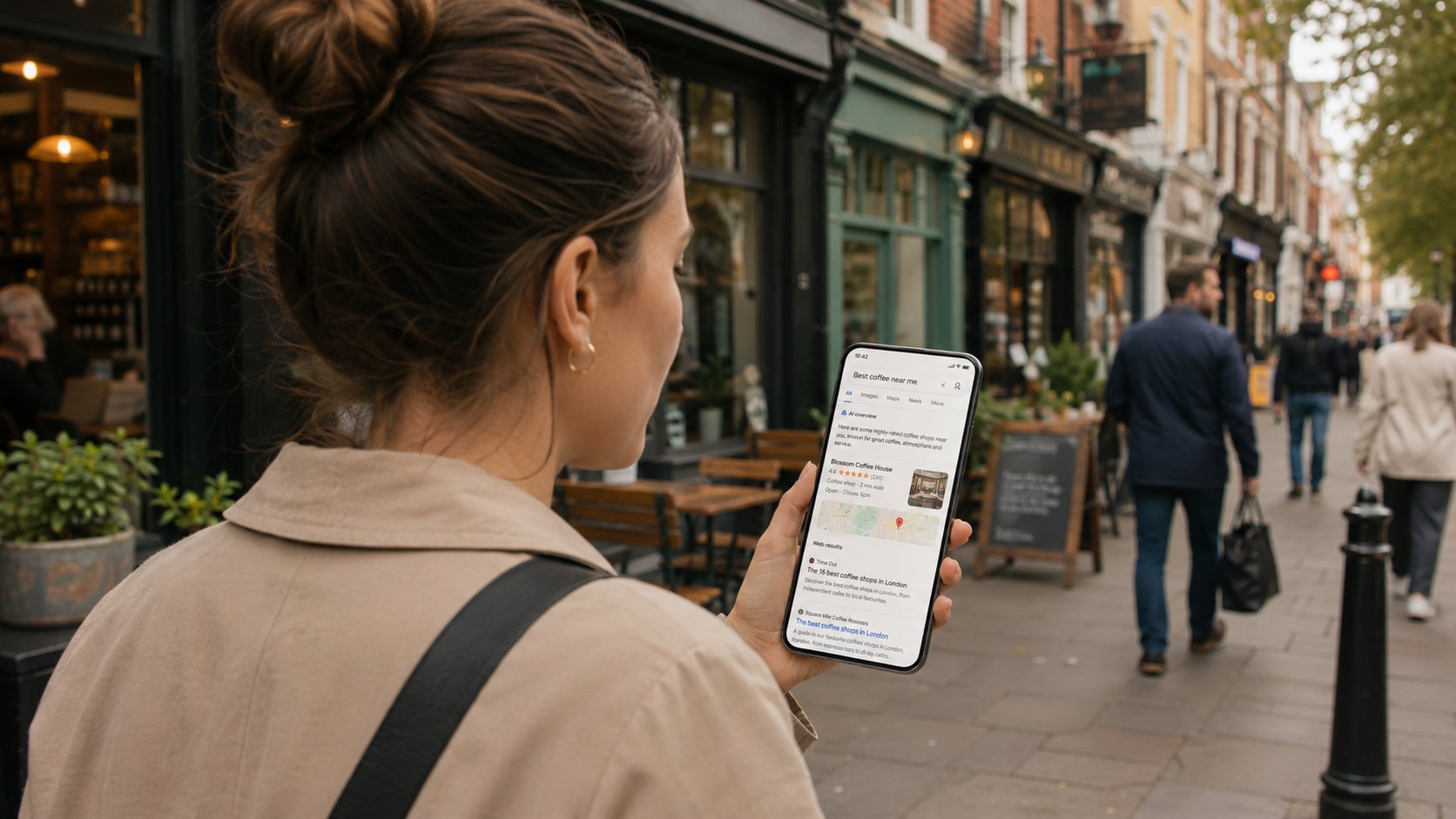
Google is not dead.
That should probably be said upfront.
Every few months another headline suggests ChatGPT, TikTok, Reddit or some other platform is about to replace it.
Meanwhile, people continue performing an extraordinary number of Google searches.
What is changing is what happens during those searches.
Google increasingly answers questions itself. People ask longer and more complicated questions. AI summaries appear above traditional results. Searchers jump between Google, social media, review platforms and AI tools.
And increasingly, appearing in search does not automatically mean somebody will click through to your website.
That is a much more interesting change than declaring SEO dead for the 97th time.
Google is still where a lot of journeys start
BrightLocal's July 2026 research into local-business discovery found that 52% of US consumers started their most recent local search on Google Search, with another 9% beginning in Google Maps.
Across the complete journey, 71% used Google Search at some point.
So businesses abandoning Google to "focus on AI" would be premature.
But the same research found something equally important: 75% used more than one channel.
used more than one channel during their recent local-business search.
Source: BrightLocal Consumer Search Behavior 2026, 1,227 US consumers who searched for a local business in the previous three months.
Search has become less like opening one directory and choosing a result.
It is becoming a research process.
Google itself is becoming an AI product
The biggest change to Google is happening inside Google.
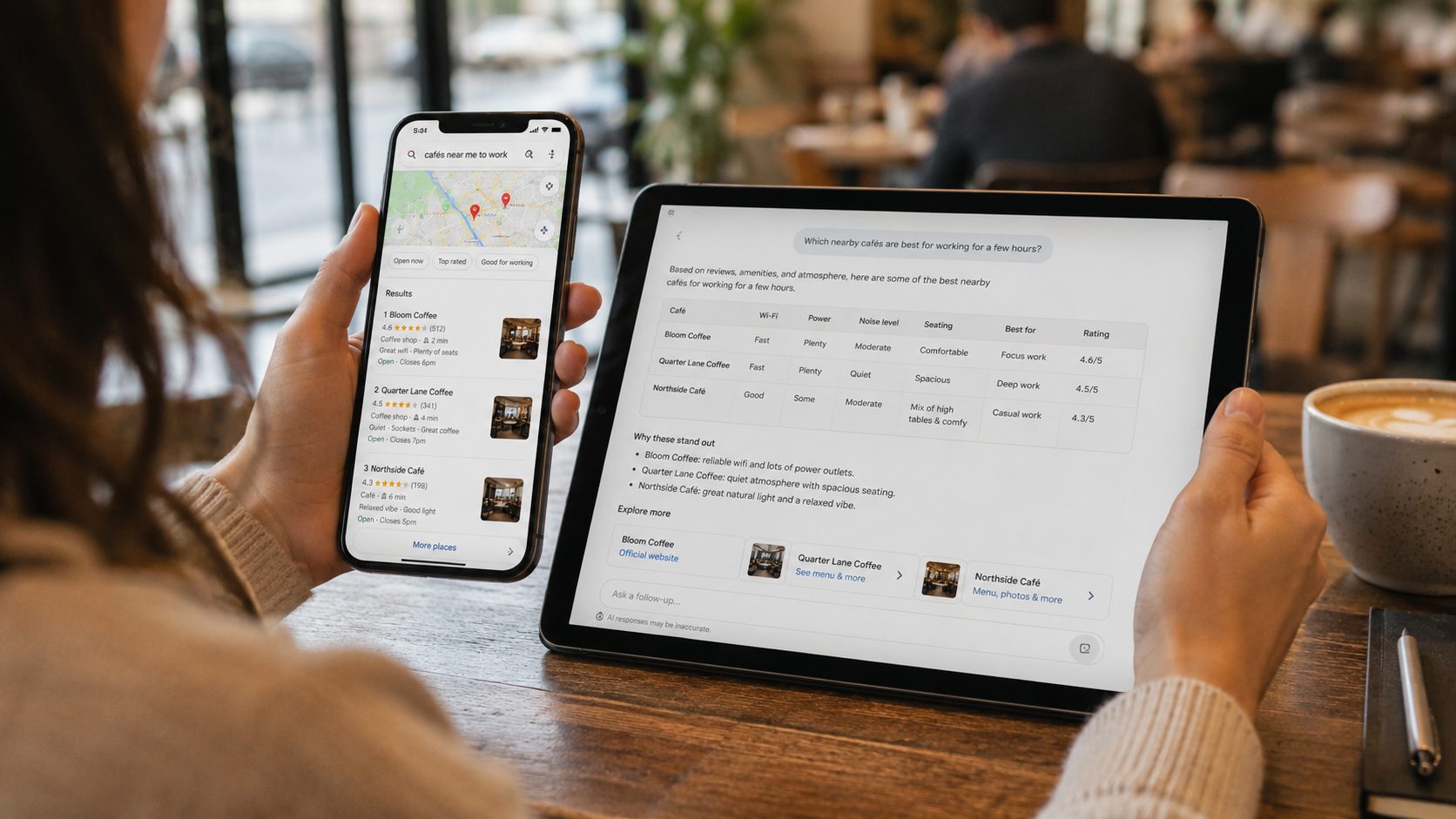
AI Overviews now provide generated answers directly above many traditional search results.
Google said in May 2025 that AI Overviews had reached more than 1.5 billion monthly users across 200 countries and territories.
It also said usage increased by more than 10% for the types of searches where AI Overviews appeared in major markets such as the US and India.
Google also introduced AI Mode, allowing much more conversational searches.
Its early users were asking questions two to three times longer than traditional search queries.
That matters because search is shifting from:
best running shoes
towards:
I run three times a week mostly on road, have slightly wide feet and tend to get knee pain. What should I look for in a running shoe under £150?
Those are fundamentally different searches.
The second is closer to a conversation than a keyword.
Sometimes Google now answers the question before the click
This is the uncomfortable bit for anyone who has spent years growing organic search traffic.
Pew Research Center analysed 68,879 Google searches made by 900 US adults in March 2025.
When an AI summary appeared, users clicked a traditional search result in 8% of visits. When there was no AI summary, they clicked a result in 15%. Links contained inside the AI summary itself were clicked in only 1% of visits.
Source: Pew Research Center, July 2025.
Source: Pew Research Center, July 2025.
An impression is no longer the same thing as an opportunity to earn a click.
Ahrefs has since reported an even larger effect.
Its February 2026 update, based on 300,000 keywords and aggregated Google Search Console data, estimated that a position-one result on a query showing an AI Overview had an average click-through rate 58% lower than its model predicted without the Overview.
That is third-party research rather than Google's own measurement, so it should be treated as such.
But it points in the same direction as Pew's observed browsing behaviour.
Search visibility and website traffic are no longer interchangeable.
This does not make having a good website less important
It arguably makes it more important.
AI systems still need information from somewhere. Customers still verify recommendations.
BrightLocal found that AI tools were used during 23% of recent local-business searches in its 2026 study.
But among people who started with AI, 43% subsequently checked Google and 39% went to social media. Only 2% used AI as their sole channel.
AI might introduce the business. Google might confirm it. Reviews might establish confidence. The website might finally convert it.
That makes consistency across your online presence more important, not less.
SEO is becoming broader than ranking ten blue links
For years, SEO conversations could become obsessed with positions.
Where do we rank? What keyword are we number one for?
Those questions still matter.
But businesses increasingly need another set:
- Does Google understand who we are and what we do?
- Is our information accurate across the web?
- Is our content good enough to be referenced when an AI answer is created?
- Do trusted third-party sites mention us?
- Does our website answer the more complex questions customers now ask?
- Are we measuring impressions, visibility and actual commercial outcomes rather than traffic alone?
A number-one ranking that sends fewer clicks may still have value. A mention inside an AI response may have value even when the resulting referral traffic is tiny.
The measurement problem is becoming harder.
Write for questions, not just keywords
This may be the most useful practical shift.
People have always had questions. Search engines are simply getting better at accepting them in natural language.
That means useful website content needs to do more than contain the right keyword. It needs to genuinely answer things.
- How does this work?
- What will it cost?
- Which option is suitable for me?
- What is the difference between these two services?
- What are the risks?
- What should I do first?
- When should I not buy this?
Those are exactly the kinds of questions businesses are often uniquely qualified to answer.
That is good content for humans. It also gives search engines and AI systems clearer information to work with.
Don't optimise for a search engine that no longer exists
There is still plenty we do not know about where search is going.
What is already clear is that the old mental model is fading:
The old model: one search, ten links, a click.
The new journey is messier:
Google remains a huge part of that journey. It just isn't playing exactly the same role it used to.
The opportunity for businesses is not to chase every new platform. It is to make sure the information, authority and experience they provide are strong enough to survive wherever the customer chooses to look.
Is your website ready for the way people search now?
We help strengthen your content, search visibility, analytics and website experience.
Let's talkFrequently asked questions
Is Google still important for small businesses?
Yes. BrightLocal's 2026 US research found that 71% of respondents used Google Search at some stage of their most recent local-business search.
Are people replacing Google with ChatGPT?
Some people are using AI tools as part of their research, but the evidence does not support Google having been replaced. BrightLocal found that many consumers moved between AI, Google, social media and reviews.
Do Google AI Overviews reduce website traffic?
Available research suggests they can reduce clicks for queries where they appear. Pew found traditional-result clicks fell from 15% to 8% in its observed searches when an AI summary was present. Ahrefs has separately measured substantial reductions in organic click-through rates.
Does SEO still matter?
Yes, but SEO needs to evolve beyond ranking positions alone. Visibility, authority, useful content, accurate information and how a business appears in both traditional and AI-assisted search are becoming increasingly connected.
Is your website ready for the way people search now?
We can help strengthen your content, search visibility, analytics and website experience for a customer journey that increasingly moves between Google, AI and other channels.
Let's talk