What should a small business actually measure online?
Traffic, clicks and rankings can all be useful. But the numbers worth watching are the ones that help you understand whether your marketing and website are actually contributing to the business.
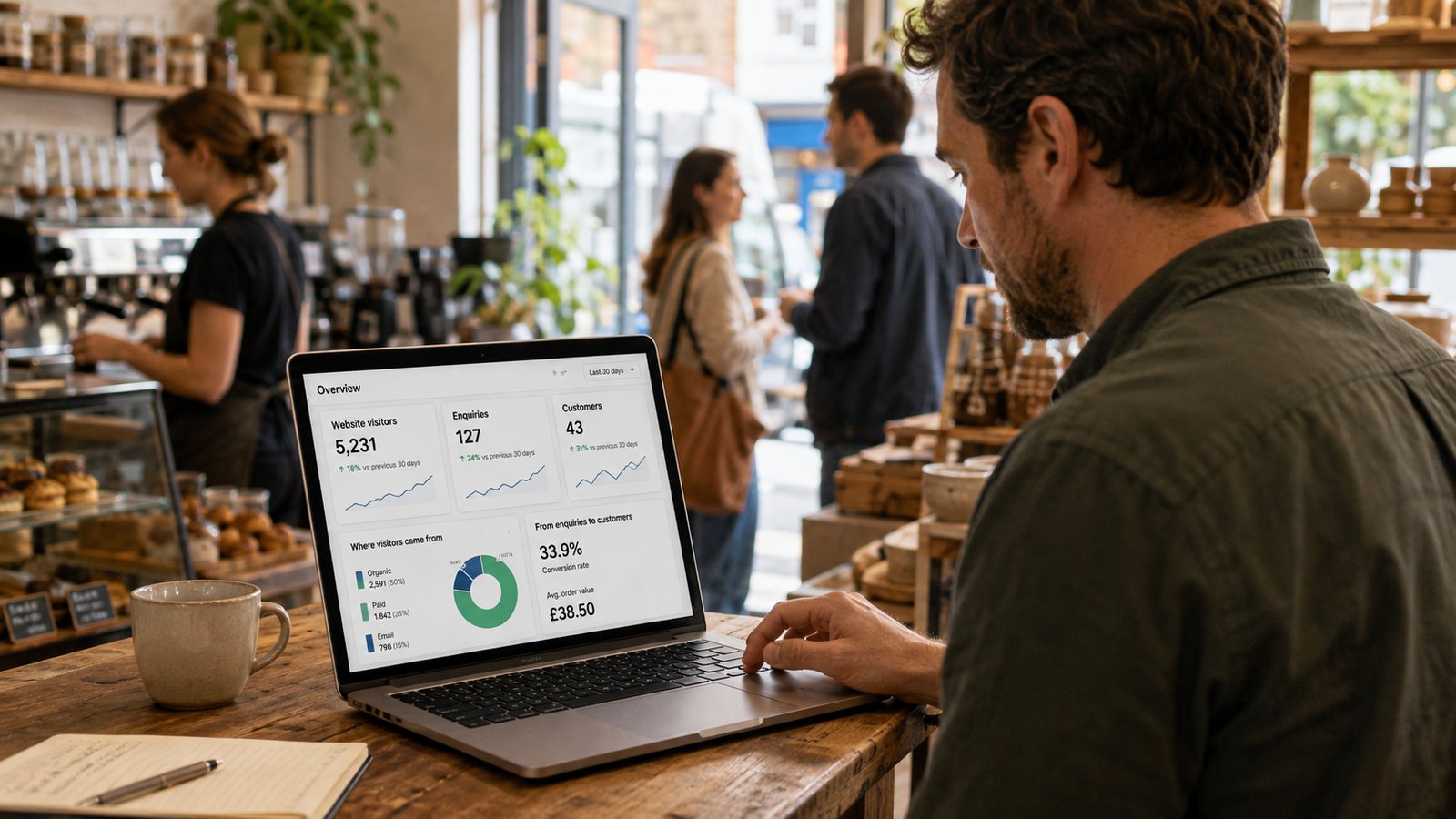
Open almost any analytics platform and you can find hundreds of numbers.
Users. Sessions. Views. Impressions. Clicks. Engagement. Rankings. Scrolls. Devices. Countries. Events.
It looks impressively detailed.
But which of those numbers actually tells you whether the website is helping the business?
For a small business, measurement should not be about collecting as much data as possible. It should be about answering a small number of useful questions.
The measurement ladder. That is a better starting point than reporting whatever appears on the default dashboard.
Start with the business question, not the metric
Traffic is sometimes dismissed as a vanity metric.
I do not think that is very useful.
If you have invested in search visibility and want to know whether more potential customers are finding you, traffic matters.
If traffic rises by 50% but enquiries stay flat, that same number creates a different question.
The metric has not suddenly become good or bad.
The context determines whether it is useful.
That applies to rankings, impressions, engagement, followers and almost anything else you can measure online.
Start with what you are trying to understand, then choose the numbers that help answer it.
Are people finding you?
For search, Google Search Console gives you a useful first layer.
It shows measures including impressions, clicks, click-through rate, queries and pages.
That helps answer things like:
- Are we becoming more visible in Google?
- Which searches are generating that visibility?
- Which pages are attracting clicks?
- Are impressions increasing without clicks following?
Visibility matters.
But it is the start of the journey, not the business result.
Where is the useful traffic coming from?
Five thousand website visits tells you very little on its own.
Knowing where those visits came from gives the number context.
Organic search, paid advertising, email, social, referrals and direct traffic can bring people with very different intentions.
The useful question becomes:
Which sources bring visitors who actually do something valuable next?
That is where traffic stops being a report number and starts becoming a marketing decision.
Which actions actually matter?
Analytics tools can measure almost anything.
A scroll. A click. A video play. A download. A form start. A form submission.
The ability to measure something does not automatically make it worth putting on your dashboard.
Google Analytics uses events to capture interactions and lets businesses identify particularly important actions as key events.
That is a good way to think about it.
For one business, that might be:
- submitting an enquiry
- booking an appointment
- requesting a quote
- making a purchase
- calling from the website
For another, there may be useful leading indicators such as viewing pricing, opening a booking tool or reaching an important step in an application.
The question is not simply did something happen? It is did something happen that tells us something useful about customer intent or business performance?
Leads and sales are where things become real
For most commercial websites, there is eventually an action that matters considerably more than the others.
Someone enquires. Someone books. Someone buys. Someone requests a quote.
If those actions are not being measured properly, everything above them becomes harder to interpret.
A polished analytics report that cannot tell you how many useful enquiries came through the website is not particularly advanced. It is just detailed.
Not every lead is equal
This is where website analytics often stops too early.
Imagine one campaign produces 40 enquiries and another produces 15.
The first campaign looks better.
Then sales tells you only four of those 40 were genuinely suitable, while 11 of the 15 from the second campaign were qualified opportunities.
The story changes.
That is why the strongest measurement eventually connects what happens on the website with what happens after it.
That might mean connecting analytics with a CRM, ecommerce data, appointment system, call tracking or sales outcomes.
A small business does not need a giant data warehouse. It does need enough connection between systems to understand whether its marketing is producing good business, not just activity.
Distance from the business outcome. The upper tiers are not "vanity". They just sit further from the commercial result, so they need more context.
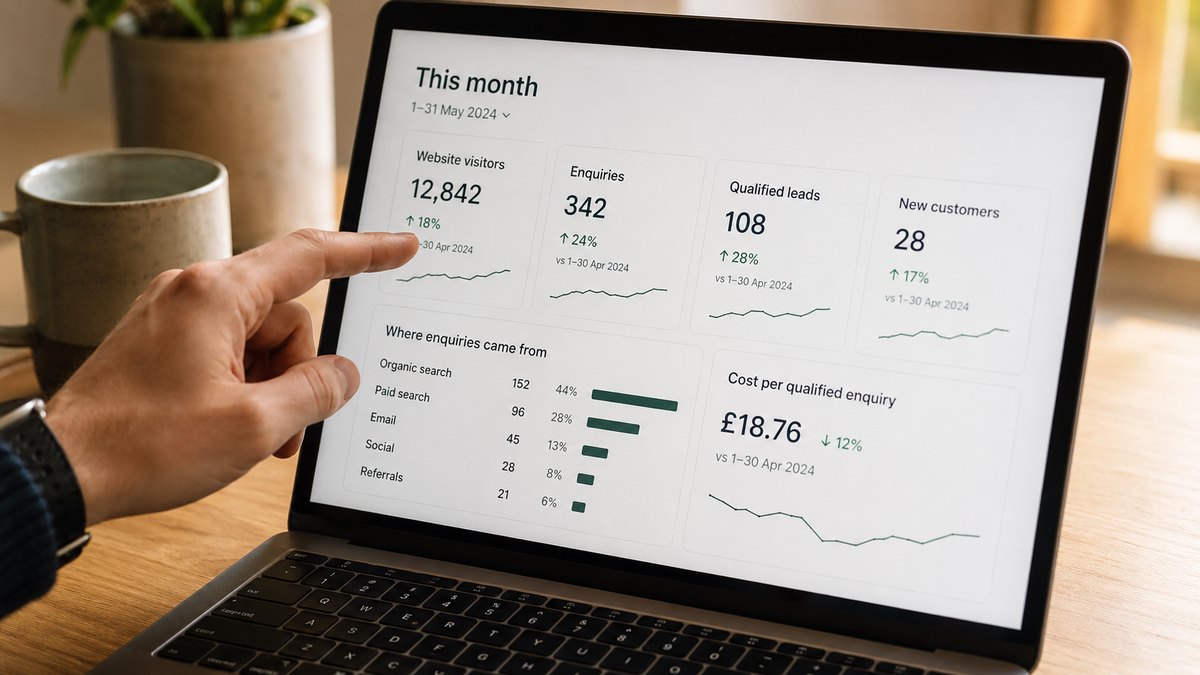
So what should actually be on the dashboard?
Probably less than you think.
A useful small-business dashboard answers five questions
- Are people finding us?
- Where are they coming from?
- What are they doing?
- Are they taking action?
- Is that action creating business?
If it does that well, it is doing more useful work than a dashboard containing 40 charts nobody really looks at.
For some businesses, Google Analytics and Search Console will be enough.
For others, it makes sense to bring website, advertising, enquiry, booking or sales data together into a custom dashboard built around the questions the business actually needs answered.
That is something we can build.
The number should lead to a decision
This is the simplest test of whether a metric deserves attention.
When it changes, does it help you decide what to investigate next?
If impressions rise but clicks do not, why? If paid traffic grows but enquiries stay flat, why? If enquiries increase but qualified opportunities fall, why?
Good measurement does not merely tell you what happened.
It helps you decide what to improve.
That is what the dashboard is for.
Frequently asked questions
What are the most important website metrics for a small business?
It depends on the role of the website. For most commercial sites, useful measurement moves from visibility and traffic through meaningful behaviour to enquiries, bookings, sales and business value.
Is website traffic a vanity metric?
Not automatically. Traffic is useful when it answers a relevant question. It becomes much less useful when reported without context or any connection to outcomes.
Do I need a custom dashboard?
Not necessarily. Standard analytics may answer the questions for a simple business. A custom dashboard becomes valuable when you need to combine data sources or make recurring business performance much easier to understand.
Want a clearer view of what your website is actually contributing?
We can help identify what is worth measuring, put the right tracking in place and build a dashboard around the numbers that matter to your business.
Let's talk